From the upload to the memo.
One draft goes in. Three adversaries read it to make it lose. One memo comes out.
The upload.
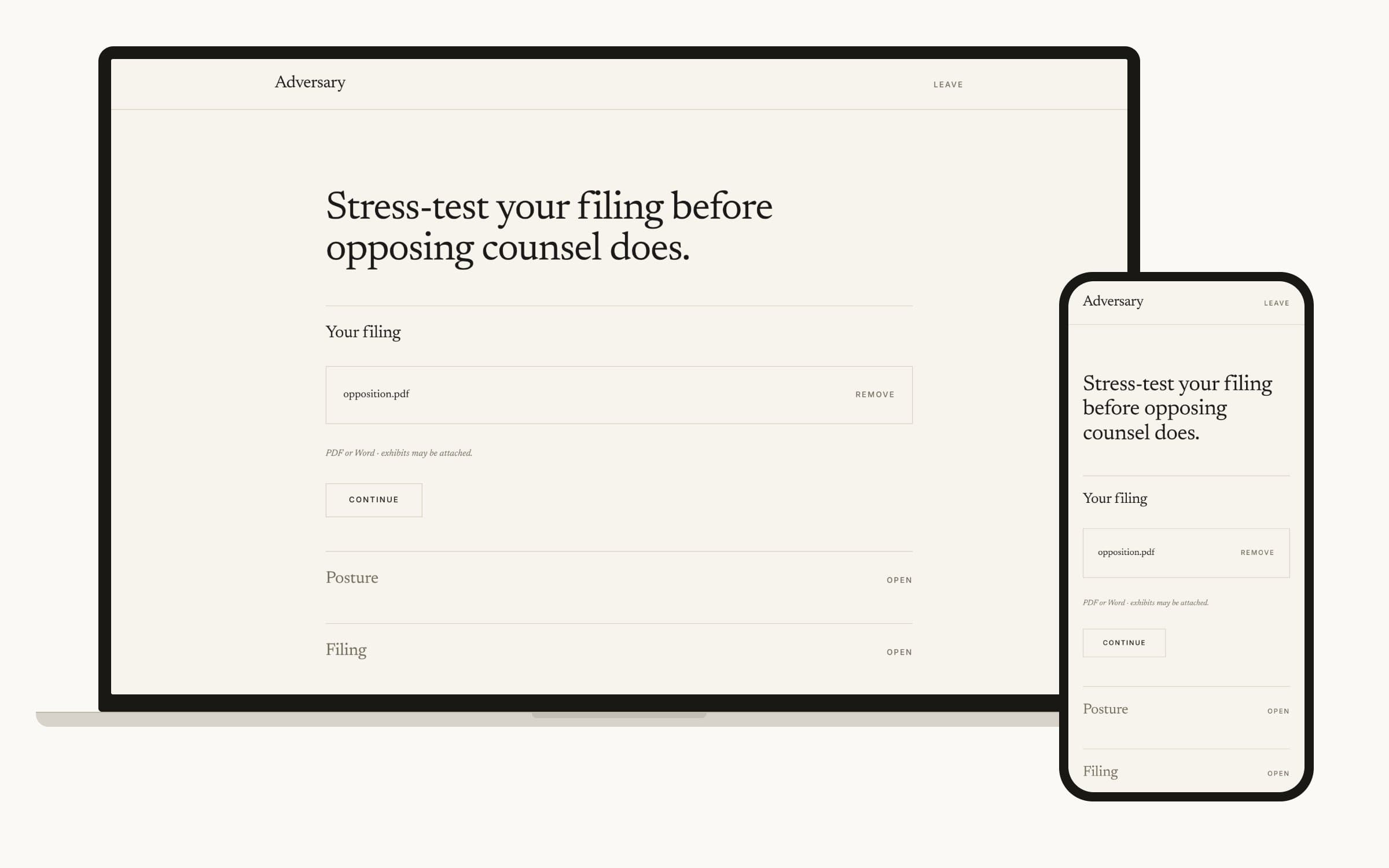
You add the draft as PDF or Word. If it answers a motion, you add the motion too, and say whether yours is an opposition, a reply or a sur-reply. A prior version of your draft can go in beside it, and the memo will say what changed.
Adversary reads the caption and says what it takes the filing to be. You confirm it or correct it. Then you choose the court, and if you have them, the judge’s standing orders.
Each file goes from your browser to temporary storage, is read into memory when the run starts, and is deleted before any analysis begins.
The reading.
A filing is a brief and its exhibits, and only the brief is argument. Adversary separates the two. Declarations filed with the brief are read with it. Exhibits are indexed and opened only where the brief cites them.
Every case is looked up on CourtListener, and the opinions the brief leans on hardest are read for whether they say what the brief says they hold. A case CourtListener does not hold is reported as not found there, never as wrong.
California statutes are checked against the Legislature’s published text for the Civil Procedure, Evidence, Civil, Business and Professions, Commercial, Corporations, Family, Labor, Probate and Government Codes. Rules of Court are checked against Titles 1, 2, 3 and 8.
The adversaries.
Opposing counsel argues from their actual papers and reports what they could not beat. The bench has read both sides and rules ground by ground. A procedural reviewer works the local rules of your court, the Rules of Court and any standing orders you uploaded, and names the rule behind every finding.
Local rules are loaded for the San Diego, Orange, Riverside and Los Angeles superior courts and the Southern District of California. For any other court, the memo says the rules are not yet loaded.
Where an issue turns on the court’s discretion, the memo says which way the facts in your record point, and what would move them.
The memo.
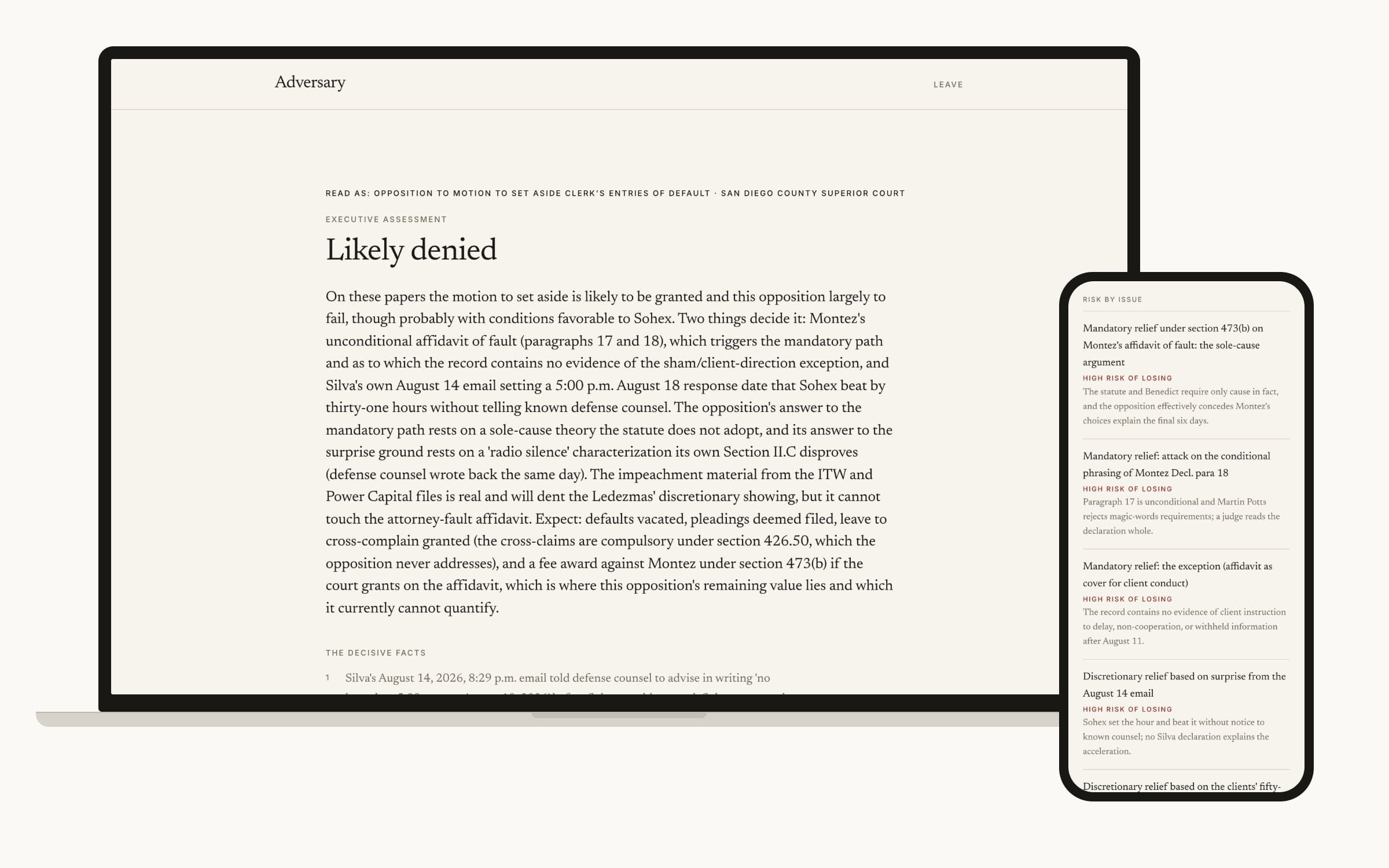
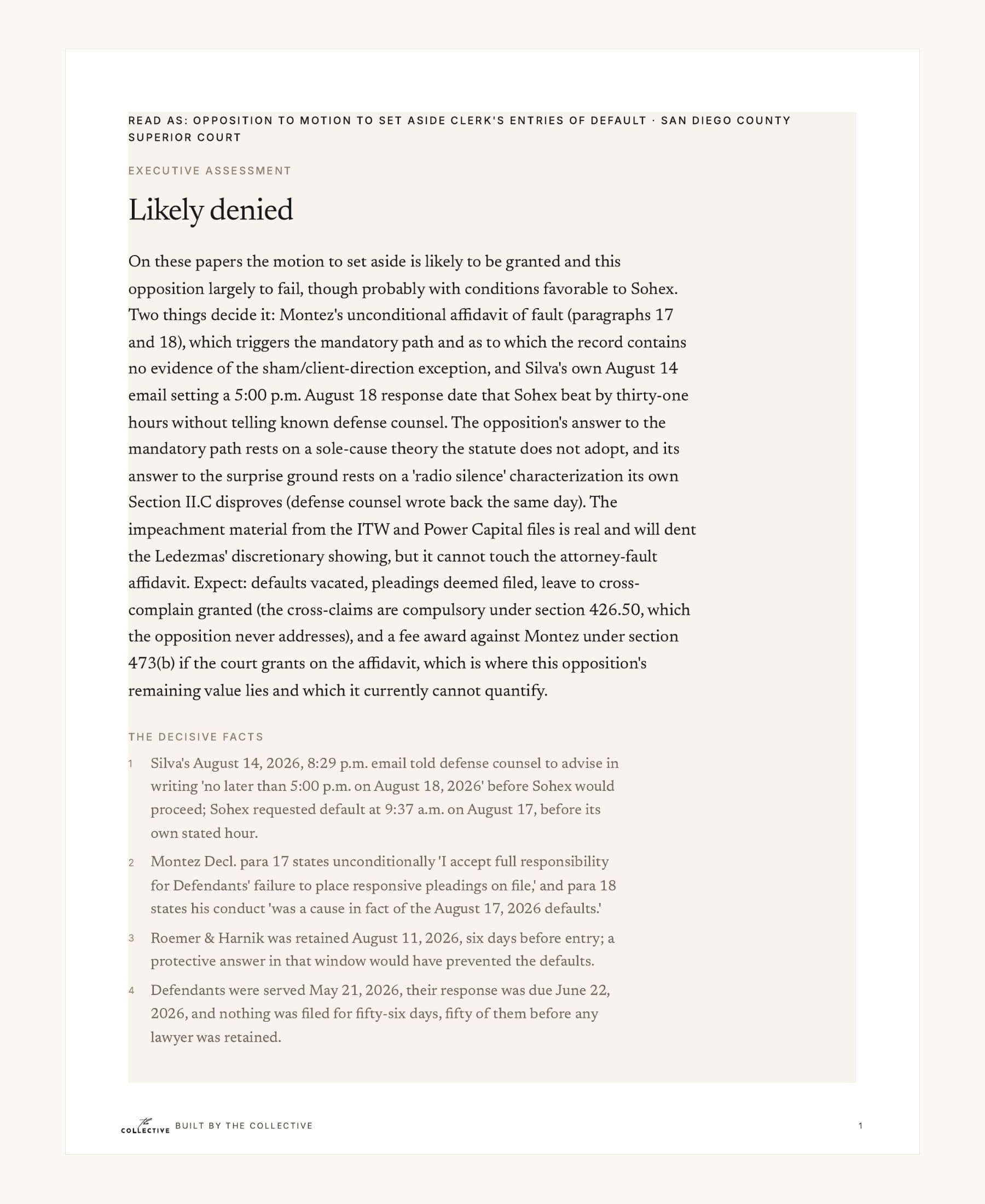
It opens on the verdict: likely granted, at risk, or likely denied, with the facts that decide it and the risk on each issue. There is no score.
Then what the filing does well, its weaknesses ranked with a correction for each, the facts and evidence the record is missing, the arguments the other side will make next, procedural and presentation issues, and one list of what to fix first. Every finding points to the page, the paragraph and the sentence.
The memo is a PDF, ready to download when the run finishes. A stress test takes about five to six minutes. Longer filings take longer.
Two shorter runs.
A pre-filing review leaves out the adversaries. It checks procedure, local rules, the Rules of Court, format, record cites, citation accuracy and proofreading, and takes about a minute and a half.
A pin-cite review checks each case cite’s pin page against the opinion’s own pagination, and takes about one minute. Run times are measured on the public Sohex papers.